
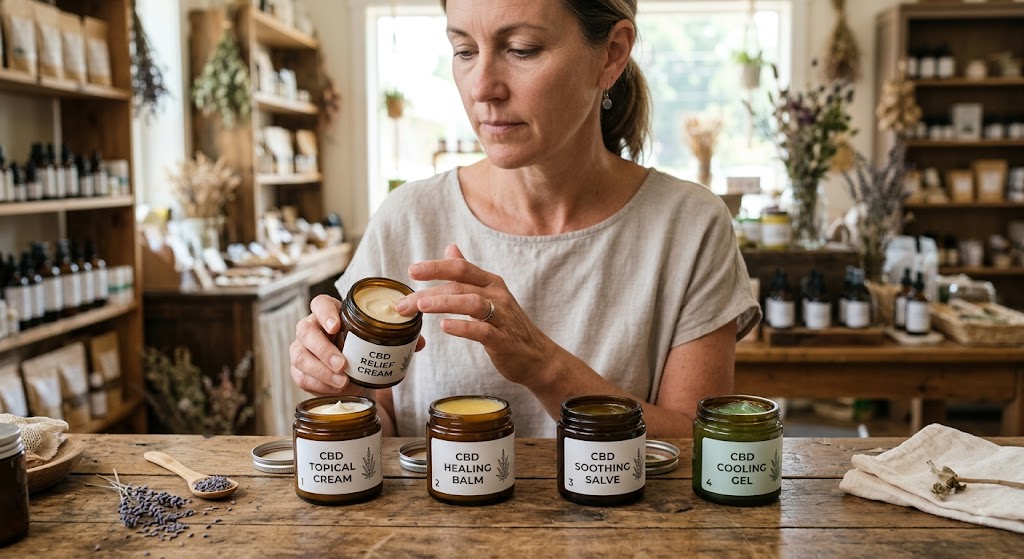
CBD topicals come in several forms, including creams, lotions, balms, salves, gels, and roll-ons. The best choice depends less on the CBD label alone and more on the product’s base, texture, intended use, skin needs, and how you want to fit it into your routine. Research on topical CBD is still developing, so shoppers should also look at ingredient quality, testing, and product claims before choosing one.
What Makes CBD Topical Formulations Different?
The main difference between CBD topicals is the base that carries CBD onto the skin. That base affects how the product feels, how easily it spreads, how long it stays on the skin, and how practical it is for different parts of your routine.
A thick salve may sit on the skin longer, while a lotion can spread over a larger area with less residue. A gel may feel lighter and dry faster. These differences matter because a product that feels unpleasant or takes too much time to apply is less likely to become a regular part of your routine.
It is also useful to separate topical products from transdermal products. A topical is generally designed for application to the skin and localized use. A transdermal product is formulated to move an active ingredient through the skin and into systemic circulation. Those are different delivery goals, and the word “topical” does not automatically mean a product works throughout the body.
Which CBD Topical Formulation Should You Choose?
Choose a CBD topical based on where you plan to use it, how much skin you need to cover, how quickly you want it to absorb, and the texture you prefer. A cream or lotion may suit larger areas, while a balm or salve can work well when you prefer a thicker product that stays in place.
Your routine should guide the choice rather than the strength printed on the front of the container. Consider these common formulations:
Creams And Lotions
Creams and lotions are often the easiest starting point for people who want a lighter product that spreads easily. They typically use a mixture of oil and water, which creates a softer texture than an oil-heavy balm or salve.
A lotion can make sense when covering a larger area, such as an arm, leg, or shoulder. It also tends to leave less of a heavy coating than an ointment-style product.
Check the rest of the ingredient list, not just the CBD amount. Fragrance, essential oils, alcohol, or other botanical ingredients may affect how the product feels on your skin. If your skin reacts easily to personal-care products, a shorter ingredient list may make it easier to identify a potential irritant.
Balms And Salves
Balms and salves are thicker because they often contain oils, butters, and waxes rather than a high water content. This gives them a more substantial feel and can help them remain on the skin longer after application.
They may appeal to people who prefer a slow, massage-based application as part of a post-workout or evening routine. The trade-off is that they can feel greasy or leave residue on clothing, especially when applied heavily.
More product is not automatically better. Start with the amount directed on the label and spread it evenly over clean, intact skin.
Gels
Gels usually have a lighter texture and can dry more quickly than oil-rich products. Some also contain ingredients such as menthol or other cooling agents that create a noticeable sensation.
That sensation should not be confused with evidence that the CBD itself is working better. A cooling or warming feeling can come from another ingredient in the formula.
If you have sensitive skin, review the complete ingredient list before choosing a gel. Alcohol, fragrance, menthol, or other active ingredients may not suit everyone.
Roll-Ons
Roll-ons are built around convenience. The applicator lets you place the product directly on a smaller area without putting the formula on your hands.
They can be useful when you want a portable option for your gym bag, desk, or travel kit. Their main limitation is coverage. Applying a roll-on over a large area can take longer than using a cream or lotion.
Does A Higher CBD Amount Mean A Better Topical?
A higher CBD concentration does not by itself tell you which topical is the better choice. The formula, amount applied, ingredient quality, and testing can all affect the overall product experience.
Look at the CBD amount in context. A label might list total CBD per container rather than the amount delivered in a single application. Two products with similar package sizes can also have different recommended application amounts.
This is one reason comparing products by a single number can be misleading. Instead, check the serving or application directions, total CBD per container, ingredient list, and independent testing information when available.
Research on topical cannabinoids has found that absorption can vary with formulation, and researchers have noted that consistent standards for topical cannabinoid products are still needed.
What Ingredients Should You Look For Beyond CBD?
CBD is only one part of a topical formula. The supporting ingredients can change its texture, feel, scent, shelf stability, and how well it fits your skin and routine.
For an oil-based product, you may see ingredients such as coconut oil, jojoba oil, shea butter, or beeswax. Water-based creams may use humectants, emollients, and emulsifiers to create a spreadable texture. Gels may rely on water, alcohol, or other ingredients that produce a lighter finish.
Think about the experience you want. If you dislike greasy residue, a heavy salve may frustrate you. If you want a massage-friendly product, an oil-rich formula may be more appealing.
Also pay attention to fragrance. “Natural” does not automatically mean irritation-free. Essential oils and fragrance ingredients can affect sensitive skin, so personal tolerance matters more than a marketing label.
How Can You Tell If A CBD Topical Is Well Made?
A trustworthy CBD topical should provide clear information about what is in the product and how much CBD it contains. Independent laboratory testing can provide another layer of information about cannabinoid content and possible contaminants.
Look for a recent certificate of analysis, often called a COA, when the manufacturer provides one. Check that the report identifies the product or batch and gives measurable cannabinoid results. Depending on the product and testing panel, reports may also provide information about contaminants such as heavy metals, pesticides, solvents, or microbes.
This matters because the FDA has reported concerns about CBD products containing different amounts of CBD than their labels claim, as well as possible contaminants. The agency also warns that many CBD products are sold with health claims that have not been adequately proven.
Be cautious when a topical promises to treat a disease, cure a medical condition, or make a strong therapeutic claim without solid evidence. In the United States, intended use and marketing claims can affect whether a product is considered a cosmetic or a drug under FDA rules.
When Should You Apply A CBD Topical?
The best time to use a CBD topical is the time that fits naturally into your routine and follows the product’s directions. Many people choose to apply topical products after physical activity, during an evening self-care routine, or whenever they want to spend a few minutes on a particular area.
Clean, dry skin can make application easier and reduce the chance of mixing the product with sweat, dirt, or other products. Use only as directed on the label.
Avoid treating application as a race. A small amount spread evenly may provide a better experience than applying a thick layer all at once. Give the product time to settle before putting on clothing if the formula is oily.
Do not apply CBD topicals to broken or irritated skin unless the product specifically says it is intended for that use. Stop using a product if you develop significant irritation or an unexpected reaction.
What Common Mistakes Should You Avoid?
The biggest mistake is choosing a CBD topical based only on its CBD percentage. A strong concentration does not tell you whether the texture, supporting ingredients, application method, or testing standards will suit your needs.
Another mistake is assuming every CBD topical works in the same way. Formulation affects how cannabinoids interact with the skin and how much may pass through it. Human research on topical and transdermal CBD remains limited, with relatively few clinical studies available.
Do not ignore the rest of the label, either. A product may contain ingredients that create a cooling sensation, add fragrance, moisturize the skin, or change how the formula spreads.
Finally, do not use a topical as a substitute for medical care. CBD research is still developing, and the FDA notes that safety questions remain, including potential drug interactions and other risks associated with CBD exposure. Speak with a healthcare professional if you take medications, have a medical condition, or have questions about whether CBD is appropriate for you.
How Can You Build CBD Into A Recovery Routine?
A good CBD routine should be simple enough to repeat. Instead of treating a topical as a standalone product, consider how its texture, scent, application method, and portability fit into what you already do.
For example, a balm may suit a slower evening ritual, while a roll-on may be easier to keep in a gym bag. A lighter cream may work better when you want to cover a larger area without a heavy finish.
This is where personalization matters. There is no single formulation that suits every person, every schedule, or every preference. The most useful product is one that you understand, enjoy using, and can incorporate into a consistent wellness routine.
Rapid Recovery takes this approach with CBD tinctures and recovery drops, topical products and salves, and customizable Recovery Ritual Stacks. Its focus on sensory experience and personal routines gives people options instead of forcing everyone into the same recovery routine.
People Also Ask About CBD Topicals
Are CBD Creams And Salves The Same?
No. Creams are generally lighter and easier to spread, while salves are thicker and often oil- and wax-based. The difference comes from the base ingredients and affects texture, coverage, and how the product feels on the skin.
How Long Does CBD Topical Take To Work?
There is no reliable universal timeline for topical CBD because formulations, ingredients, application areas, and individual responses differ. Human evidence on topical CBD remains limited, so product labels should guide use rather than promises of a specific onset time.
Can You Use CBD Topicals Every Day?
Daily use depends on the specific product, its directions, your skin, and your overall CBD exposure. Because CBD safety questions remain, especially around repeated exposure and interactions, discuss regular use with a healthcare professional if you take medications or have health concerns.
Does CBD Topical Make You Feel High?
CBD itself is not the intoxicating compound associated with the “high” from cannabis; THC is responsible for that effect. Still, CBD products can contain varying amounts of cannabinoids, so checking the product’s cannabinoid information and independent testing is sensible.
Choose The Formula That Fits Your Routine
Choosing between CBD creams, lotions, gels, balms, salves, and roll-ons comes down to more than CBD concentration. Consider the base, ingredients, application area, texture, testing, and how naturally the product fits into your routine.
For thoughtfully made CBD topicals and personalized recovery options, Rapid Recovery offers topical and salve products alongside recovery drops and customizable Recovery Ritual Stacks. Explore Rapid Recovery to find a CBD routine built around your preferences, from post-workout rituals to everyday recovery.